
Complete Pack of Playing Cards known as
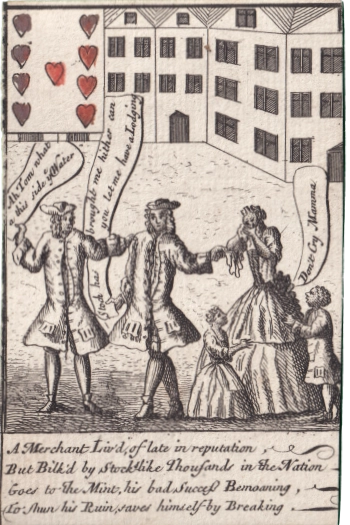
"Humours of Change Alley" / "Stock-Jobbing Cards"
published by Thomas Bowles c1720
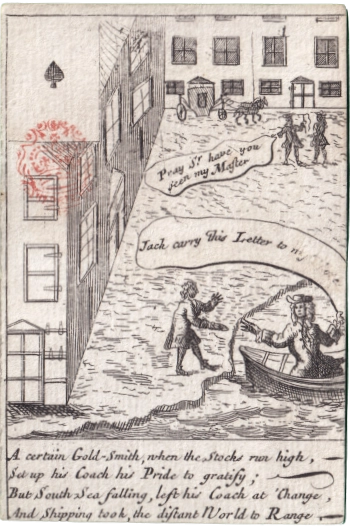


There were two main sets of playing cards published recording/caricaturing the follies of greed which became almost endemic and bankrupted a range of merchants as well as causing
financial ruin to the 'upper classes'
Some of the schemes will look as obvious scams to us today being more aware of fraud,
pyramids and bubbles.
But lessons ae never learnt as perpetrators get more sophisticated and greed seems to be in our DNA
This is a complete set of 52 ards and
the Ace of Spades bears the Red Sixpence duty stamp for the period.
The cards have a few small issues, which can be seen on the pictures below,
but this is a rare deck even more so as it is the first edition.




Background: The South Sea Bubble
- The South Sea Company was established in 1711 to manage and consolidate British national debt and to trade with Spanish colonies in South America.
- By 1720, speculative trading in the company’s shares led to a massive financial bubble, which burst disastrously, causing widespread ruin among investors and shaking public trust in financial markets.
- This event gave rise to a great deal of satirical literature and imagery, which criticized the greed, gullibility, and speculative mania of the time.
The Cards and Their Satirical Purpose
- The Stock-Jobbing Cards reflect the public mood of disillusionment and satire surrounding the South Sea Bubble.
- Thomas Bowles, a well-known London print seller, likely published these cards as part of the satirical trend that emerged following the bubble’s collapse.
- Each card depicts a scene or a character involved in speculative trading—often portrayed humorously or with biting irony


Symbolism and Schemes Depicted
- Allegory of Greed and Folly: Many cards employ allegorical imagery, such as Fortune, bubbles, and collapsing structures, to represent the fleeting nature of speculative wealth.
- Ruined Investors: Scenes often show individuals lamenting their financial losses, symbolizing the widespread ruin caused by the collapse.
- Brokers and Tricksters: Stock-jobbers are caricatured as cunning or dishonest, preying on naïve investors.
- References to the Bubble Companies: Some cards allude to fraudulent “bubble companies” (fake ventures) that arose to exploit the speculation craze. Many promised absurd profits or fantastical schemes to attract investors.
Auction Sale 2013 a similar set sold for £32,500 at Sotheby's
Thomas Bowles’ Stock-Jobbing Cards are a vivid reflection of 18th-century England’s financial excesses and the societal response to one of history’s most infamous economic bubbles. They stand as both a cautionary tale and an example of how satire was used to critique contemporary events
Engraved cards with stencilled pips.
Plain Packs.
J R S Whiting -
Handful of History
Catherine P Hargrave -
A History of Playing Cards
British Museum E202.2
Schreiber, Lady Charlotte Playing Cards of various Ages and Countries: Selected from the Collection of Lady Charlotte Schreiber. Volume I. English, Scottish, Dutch and Flemish. John Murray, London, 1892References


Features of the Cards:
- Visual Satire: The cards are richly illustrated with engravings that lampoon various aspects of stock-jobbing (stock trading) and speculation.
- Moral Commentary: They serve as a moral critique, warning against avarice, credulity, and the folly of gambling on the stock market.
- Key Characters: Figures depicted include speculators, brokers, ruined investors, and others caught up in the financial chaos. Their actions are exaggerated to highlight the absurdity of the bubble.
Cultural and Historical Impact
- The Stock-Jobbing Cards are part of a broader tradition of satirical playing cards, which combined entertainment with social and political commentary.
- They provide a snapshot of public sentiment in the aftermath of the South Sea Bubble, offering insight into how people processed the scandal through satire and humor.
- The cards are valuable historical artifacts, shedding light on early capitalism, speculative manias, and their cultural consequences.
This site is owned by – TSSDA © Games et al 1999 – 2026 – Zen